I tried!

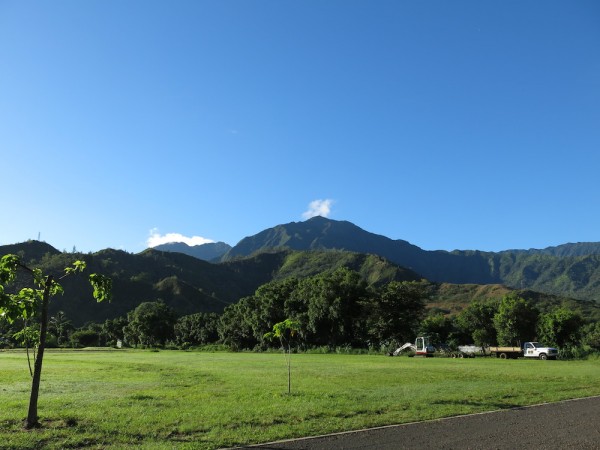
I thought I was going to get lost, at least after reading the directions I got.
“Waipa is about 1/2 mile past Hanalei town (after Wai`oli bridge…a one lane concrete bridge) on the left. Look for a stop sign and 2 lane paved driveway. When you turn in you can park where the other cars are on the grass on the right where the road splits. Just walk over to the poi garage and ask for me if I don’t walk out to you.”
OK. Half a mile from Hanalei Town. After a concrete bridge. Somewhere on the left.
I was hoping Stacy Sproat-Beck, the executive director of the Waipa Foundation, a nonprofit that perpetuates the Hawaiian culture and manages a 1,600-acre ahupuaa (ancient Hawaiian land division) in Waipa on Kauai’s north shore, had given me enough detail to find the place.
Because it’s not that easy to find.
First off, the “2-lane paved driveway” isn’t really paved, at least not in the Honolulu sense. And there’s really no stop sign that you can see right off. The nonprofit is really in a couple of old homes set back from the road and surrounded by trees and a huge grassy yard where people had parked their cars. From a distance you could see the “poi garage,” really an open two-car garage where people gathered for the foundation’s weekly Poi Day, where volunteers come to join the kupuna (elders) and staff in making poi using the kalo (taro) grown on the island. But to be honest, I wasn’t really sure I had found the right place until I walked right into the garage and saw the taro myself.
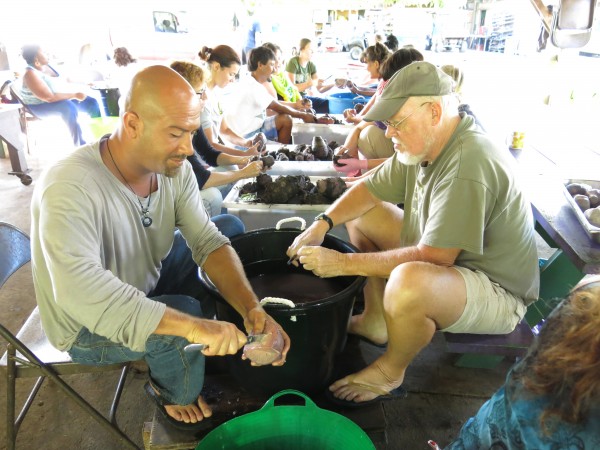
But the long drive from Lihue Airport — after getting up at 4 a.m. that morning — was well worth it.
Waipa is fascinating.
In ancient times, the mauka area of the ahupuaa was known as Wao Akua, or the Realm of the Gods. People rarely visited here. This is where you’d find wood for canoes and bird feathers for capes for the alii (royalty). Today, the foundation is restoring the native forests — an integral part of the ahupuaa system — which had been destroyed by the sandalwood trade, cattle ranching and non-native species that have taken over the area. Just in the past few years, more than 2,000 native trees and shrubs have been planted here.
Below this is the kula zone, the foundation is creating and restoring the wetland and dryland farming areas. There is a 2-acre loi (irrigated terrace) here farmed by Waipa staff and volunteers.
And below that is the ocean, where the foundation has restored one of seven acres of the Halulu fishpond, already teeming with mullet and tilapia.
At every site is a learning opportunity — and the Waipa Foundation maximizes their value to the community. They cultivate the land and restore natural habitats — and share that with anyone who wants to learn.
Poi Day is a great example of how this organization helps its community.
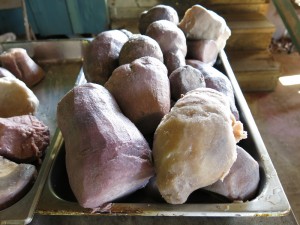 Not only is everyone invited to participate — poi-making starts at 5 a.m. and ends around noon with a lunch prepared by the staff — but the poi is then distributed to local families on Kauai. The weekly gathering was started more than 20 years ago by the Hawaiian families along the island’s north shore to feed themselves and others in their community.
Bags cost $3 a pound, $1 a pound for kupuna. The nonprofit isn’t trying to make money — they’re trying to keep this staple available and affordable to local families. And in the meantime, the staff and kupuna are sharing their knowledge about kalo and poi and their Hawaiian heritage.
It was an experience unlike any other.
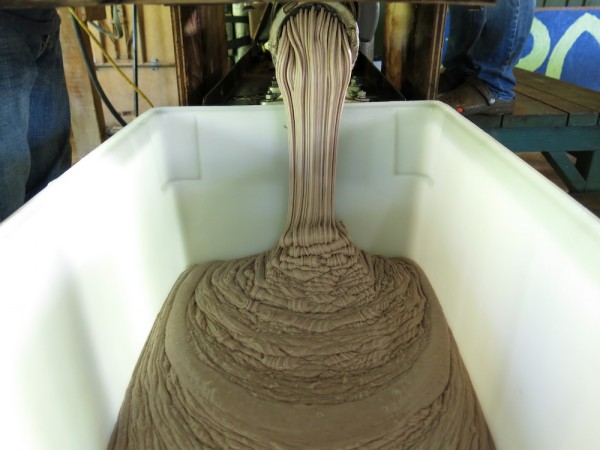
Growing up on Oahu to a dad who was raised with his Hawaiian cousins, poi has long been a staple dish at home. We eat it all the time — with beef stew, with kalua pig, by itself. It’s what we grew up on.
But I had never seen poi being made like this, never seen an entire community come together to prepare this taro dish. It was interesting and humbling at the same time.
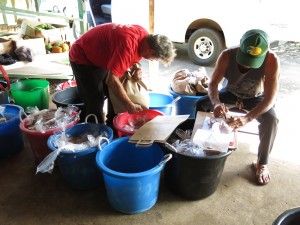 I helped clean the taro, removing warts and other imperfections with a butter knife. And I helped bag the taro in 1-, 2-, 3- and 5-pound plastic bags. I wasn’t there longer than a few hours, but it was enough to show me what it means when people say, “It takes a village.”
These folks are living proof.
Poi Day, Waipa Foundation in Hanalei, Kauai. Every Thursday starting at 5 a.m. Wear casual clothes that you don’t mind getting dirty and comfortable footwear. (808) 826-9969.

When my blogger pal, Kathy YL Chan, came to Honolulu, she was determined to do one thing: eat.
(This is why we get along.)
So after an afternoon at Shirokiya indulging in coffee jelly drinks and gossiping about life — OK, boys — she said, “Hey, you wanna check out this truffle place in Manoa?”
“Uh, of course.”
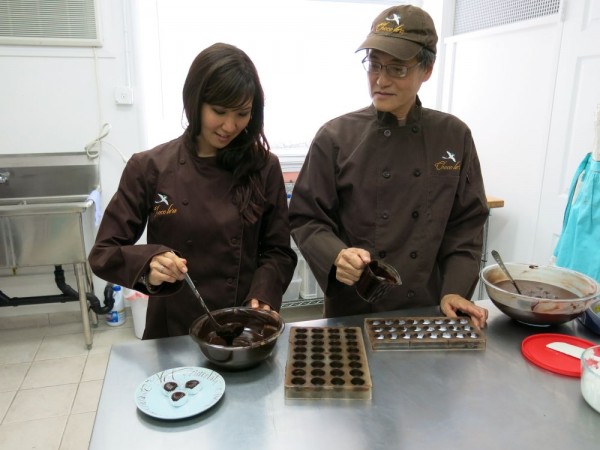
So the following Wednesday, we met up at Morning Glass Coffee + Cafe in Manoa to meet Erin Kanno Uehara, the artisan chocolatier at Choco le’a, a gourmet chocolate company founded by her cousin, Colins Kawai, in 2010. (Both pictured above.)
Uehara, a dance instructor who quit her job as a school teacher to work full-time as a chocolatier, didn’t seem like one of those people who crave chocolate. She’s tiny. But she gets her energy from somewhere — we found out later, she eats a chocolate-covered Oreo every day.
So she’s perfect for the job.
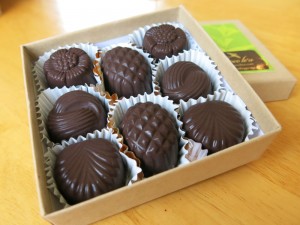 She handed us each a box of truffles — and we were all instant friends. Every dark chocolate truffle starts with high-quality Belgium, French and Swiss chocolates. (Some truffles use locally grown cacao from Waialua.) They stick to fresh, wholesome ingredients — organic and natural when possible — and avoid using preservatives, additives and artificial colors.
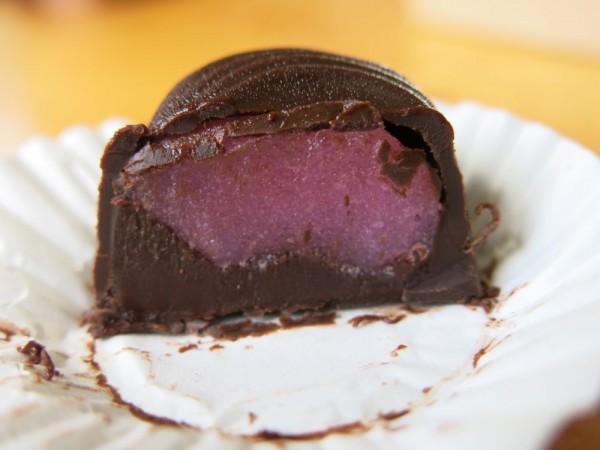
In the box Uehara gave us contained four of the company’s best-selling truffles: a triple chocolate truffle that uses local and European chocolates, one filled with lychee liqueur, one with a piece of cheesecake by Otto Cake inside and — one of its most popular items — a truffle with a pink chichi dango (mochi) from Nisshodo Mochiya in Kalihi (shown below).
But the list goes on.
They make truffles filled with everything from carrot cake to dragonfruit to Earl Grey tea. And they have a very fun list of liqueur-filled truffles like B-52 Bombers, Dom Perignon champagne, Mai Tai, amaretto, Kahlua, limoncello, lime mojito, sake, merlot and Guinness. Yes, the beer.
Since the bulk of its business is catering and special events — you can buy Choco le’a chocolates only at LMS Boutique (2909 Lowrey Ave.) in Manoa — you can pretty much ask for whatever filling you want. They’ve done tofu, bacon, wasabi, poi and sweet potato.
And since these truffles will be consumed quickly — meaning, they’re not sitting in a box on a shelf in a chocolate shop somewhere — they can be creative with fresh (read: perishable) ingredients and presentation. Like fresh strawberries or mangoes topped on an open truffle.
“We shine when we cater,” says Kawai, who made his first truffle from a recipe in Sunset Magazine 12 years ago. “It’s when we are at our best.”
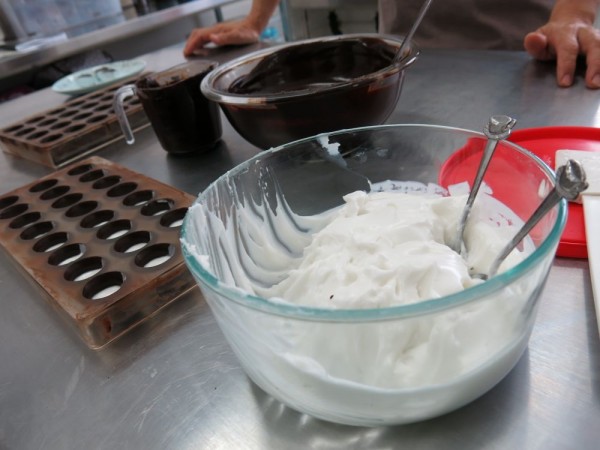
Today, Choco le’a truffles are quietly everywhere, from weddings and spas at the Moana Surfrider and Halekulani hotels to catered events like the recent Oracle Corporation’s Club Excellence 2013 celebration at Fort DeRussy, for which they provided 6,500 truffles. (Below is the ingredients for the haupia-filled truffles they made for the event.)
“It’s been very magical,” Uehara says. “I never realized how much people connect to chocolate.”
And everything is made by hand every day in the company’s new 300-square-foot kitchen in Manoa.
“Our goal is to make some of the best and tasty truffles in the world,” Kawai says, smiling.
And they’re definitely on their way.
***
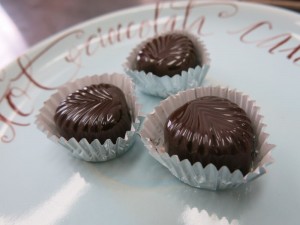 Choco le’a truffles and other treats — like the chocolate-covered Oreos they can’t seem to keep in stock — are available at LMS Boutique in Manoa. (It’s right around the corner from Choco le’s little factory.) The flavors rotate, but the company’s most popular are usually available.
You can also sign up to join Club Choco le’a for $30 monthly subscription and get a box of 20 truffles at the start of each month. Visit www.chocolea.com.
***
Read Kathy YL Chan’s blog about Choco le’a at Biting Commentary.
It’s amazing how hard it was to narrow down my favorite moments in Los Angeles to just 10.
And we were only there for five days!
There was our first meal, right off the plane, at In-N-Out Burger. Or the melt-in-your-mouth soup dumplings Din Tai Fung Dumpling House in Arcadia with a new group of LA pals. Or meat pies from Mac’s Chips & Fish Shop in Santa Barbara.
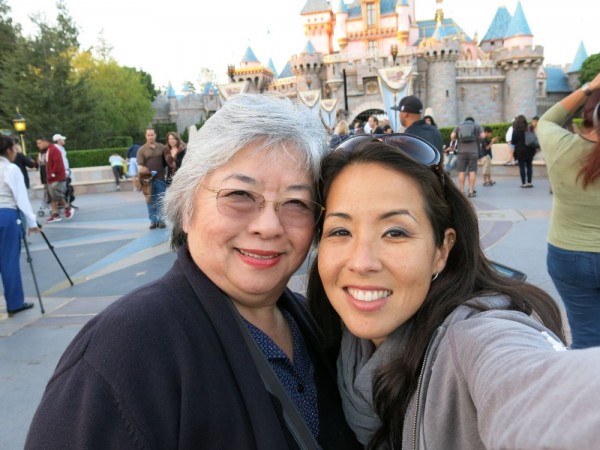
But the best part, hands down, was just spending time with my mom, whether it was watching “The Heat” on my laptop on our room in Topanga or walking around Disneyland (above), something we haven’t done in more than 30 years.
So here are my Top 10 moments in L.A., in no particular order:
Thanks to everyone who followed our adventures in Los Angeles here, on Instagram and on Twitter. Hope you had as much fun as we did! Diet tomorrow!
The only request I had for my LA pal Jay Terauchi was to take me to a few good bakeries.
So he took me to three.
One was a dessert boutique that had opened a month earlier, the other a Taiwanese cafe that specialized in bread.
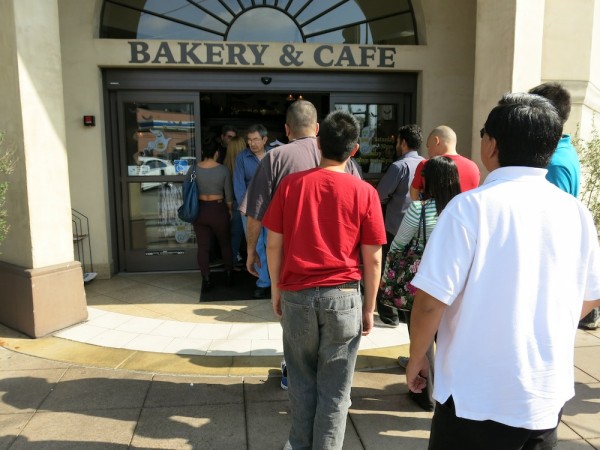
But the last one was an established bakery with three locations in the Los Angeles area and a loyal following. It was called Porto’s Bakery & Cafe.
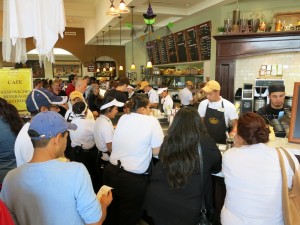 Jay warned me about this place: it wasn’t going to be the absolute best pastries I’d ever eat. But everything was good, the service is fast, and you can’t beat the prices.
And maybe that’s the recipe for a great bakery.
Here’s the story about Porto’s: Back in Cuba, Rosa Porta lost her job as a home economics teacher and began selling cakes from home to pay the bills. When the family moved to California, she continued to sell her home-baked cakes. It got so popular — there would be 15 to 20 cars a day driving up to the house to pick up cakes — she decided to open a tiny brick-and-mortar shop (just 300 square feet) in the Silverlake area in 1960.
Two generations later, the bakery has grown to three locations with a 52,000-square-foot production and distribution center in Commerce and hundreds of employees.
Rosa’s son, Raul Porto Jr., runs the bakery, which now features Cuban-style sandwiches, potato balls, meat pies, fruit tarts and other baked delights.
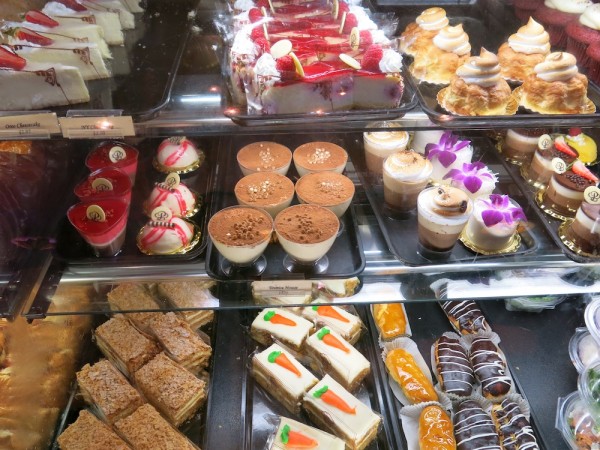
And the price — well, you can’t beat it. Chocolate croissants are $1.60 each. A French baguette is $1.65. The apple strudel was 90 cents. And the meat pies are just 78 cents each.
It’s no wonder people were walking out with boxes and boxes of goodies. Not only are the baked goods tasty — I could have eaten six of those meat pies! — but they’re affordable.
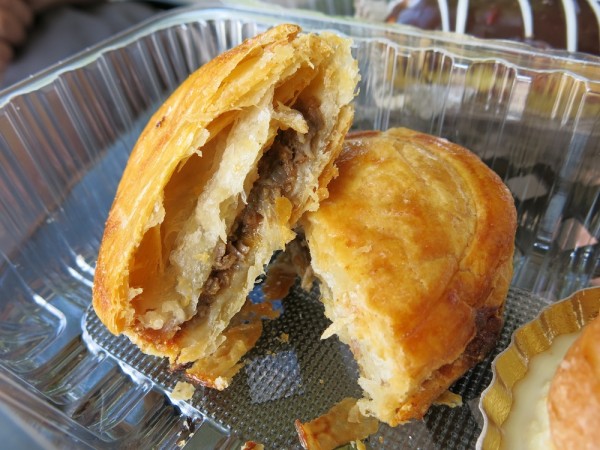
We ordered a bunch of different things, including the meat pie (shown above). I love the flaky crust and the savory filling with just enough to create a nice balance between the puff pastry and the meat inside. We also tried the chorizo pie (90 cents), which was a bit dry for me.
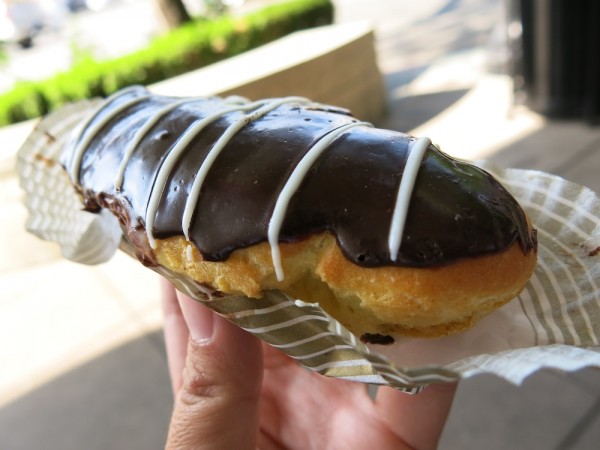
The chocolate eclair (above) was just $1.60 each and the bakery didn’t skimp on the custard filling at all. There was really nothing wrong with this eclair except that I didn’t get a second one.
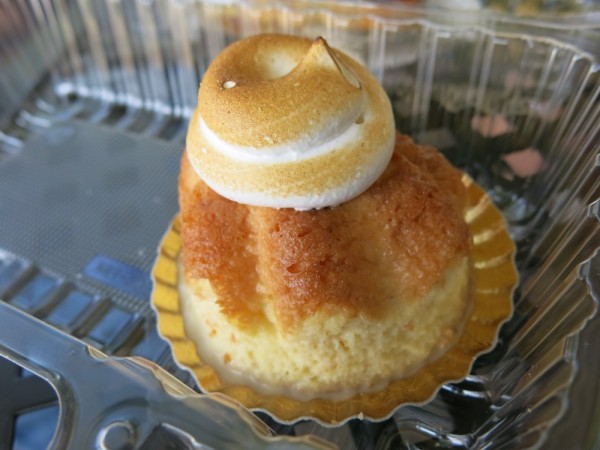
But really the star of our afternoon was this mini tres leche cake (above). Just $1.95, this traditional “three milks bread” was everything it’s supposed to be: a buttery cake soaked in three kinds of milks (evaporated, condensed and heavy cream), so light and soggy and perfect.
I was full earlier — until I ate this. Suddenly, I was hungry again.
Porto’s Bakery & Cafe in Burbank, 3614 W. Magnolia Blvd. Hours: 6:30 a.m.-7:30 p.m. Monday through Saturday, 7 a.m.-6 p.m. Sunday. Phone: (818) 846-9100.